<?xml version="1.0" encoding="utf-8"?><feed xmlns="http://www.w3.org/2005/Atom" ><generator uri="https://jekyllrb.com/" version="3.10.0">Jekyll</generator><link href="https://stevenbergner.github.io/feed.xml" rel="self" type="application/atom+xml" /><link href="https://stevenbergner.github.io/" rel="alternate" type="text/html" /><updated>2026-11-16T13:31:57+00:00</updated><id>https://stevenbergner.github.io/feed.xml</id><title type="html">Steven Bergner — Research</title><subtitle>At the interface between digital and analog worlds
</subtitle><entry><title type="html">Structured interpretation of EEG reports with language models</title><link href="https://stevenbergner.github.io/research/eeg-report-interpretation/" rel="alternate" type="text/html" title="Structured interpretation of EEG reports with language models" /><published>2026-10-27T00:00:00+00:00</published><updated>2026-10-27T00:00:00+00:00</updated><id>https://stevenbergner.github.io/research/eeg-report-interpretation</id><content type="html" xml:base="https://stevenbergner.github.io/research/eeg-report-interpretation/"><![CDATA[<blockquote>
  <p><strong>Status:</strong> public medRxiv version 2; manuscript under submission. This is a
preprint, not an accepted journal publication, and it has not been certified
by peer review.</p>
</blockquote>

<p>EEG reports preserve specialist interpretation, but their narrative form makes
cohort-scale analysis difficult. This study asks a bounded question: can a
locally run, grammar-constrained language model convert free-text EEG reports
into structured research annotations without discarding the certainty expressed
in the original interpretation?</p>

<p><a href="https://www.medrxiv.org/content/10.64898/2026.07.07.26357190v2">Read medRxiv version 2</a> · <a href="https://doi.org/10.64898/2026.07.07.26357190">Cite the DOI</a></p>

<h2 id="abstract-at-a-glance">Abstract at a glance</h2>

<ul>
  <li><strong>Objective.</strong> Extract structured diagnostic labels and label-certainty tiers
from unstructured, free-text EEG reports.</li>
  <li><strong>Evaluation.</strong> Compare grammar-constrained local models with a designated
Reference Annotator, a second certified EEG technologist, and lower-resource
NLP baselines while keeping the output schema inspectable.</li>
  <li><strong>Main result.</strong> For overall abnormality, Mistral-7B reached 96% Core
Agreement with the Reference Annotator; the second annotator reached 98%.
The local model also recovered rare epileptiform findings for which the
tested baselines produced few or no true positives.</li>
  <li><strong>Remaining difficulty.</strong> Among reports whose absence-or-presence decisions
already matched, exact certainty tiers agreed about 80% of the time for
Mistral-7B versus 90% and 94% for the second annotator on the two evaluated
report sets.</li>
  <li><strong>Boundary.</strong> These are agreement results for research annotation. They do
not establish diagnostic ground truth, external validation, or readiness for
clinical deployment.</li>
</ul>

<h2 id="one-label-three-views-of-agreement">One label, three views of agreement</h2>

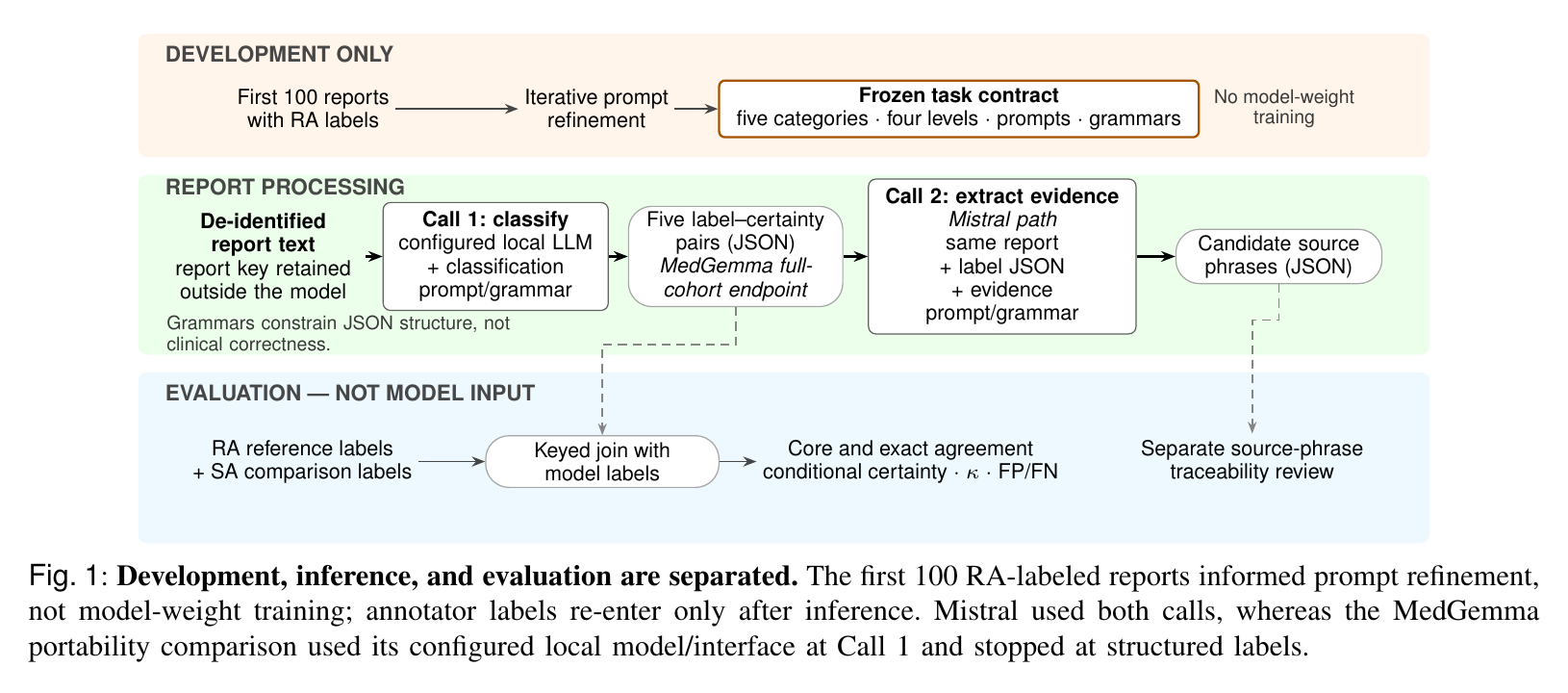
<p>The schema encodes five judgments—overall abnormality and four specific
finding categories—on one four-level ordinal scale. Each label pairs a
presence-or-absence decision with an expressed certainty tier.</p>

<p>That distinction matters because a binary label can preserve the direction of
an interpretation while erasing how firmly it was expressed. Treating
certainty as part of the structured output makes that loss measurable rather
than hiding it inside a single accuracy number.</p>

<div class="confidence-scale" aria-label="Four-level label-certainty scale">
  <div class="confidence-level"><strong>1</strong><span>certain absence</span></div>
  <div class="confidence-level"><strong>2</strong><span>low-certainty absence</span></div>
  <div class="confidence-level confidence-presence"><strong>3</strong><span>low-certainty presence</span></div>
  <div class="confidence-level"><strong>4</strong><span>certain presence</span></div>
</div>

<p>That single label supports three nested readings:</p>

<ul>
  <li><strong>Core Agreement</strong> asks whether the compared labels agree on absence (levels
1–2) versus presence (levels 3–4).</li>
  <li><strong>Certainty-Adjusted Agreement</strong> requires the same exact level from 1 to 4.</li>
  <li><strong>Conditional Certainty Agreement</strong> asks, among decisions that already match
on absence or presence, what proportion also match on the certainty tier. It
is an agreement proportion, not a calibrated probability.</li>
</ul>

<blockquote>
  <p><strong>Exact four-level agreement = Core Agreement x Conditional Certainty Agreement.</strong></p>
</blockquote>

<figure class="eeg-pipeline-teaser">
  <a href="/assets/img/eeg-structured-pipeline.png"><img src="/assets/img/eeg-structured-pipeline.png" alt="Diagram separating prompt development, local EEG report processing, and agreement evaluation" /></a>
  <figcaption>The paper separates development, local report processing, and evaluation. Reference labels re-enter only after inference, and grammars constrain machine-readable structure rather than clinical correctness.</figcaption>
</figure>

<h2 id="what-the-pipeline-contributes">What the pipeline contributes</h2>

<p>The pipeline joins three properties that are often separated: local execution
over de-identified narratives, grammar-constrained machine-readable output,
and an evaluation that keeps the core decision distinct from agreement on
certainty. A bounded portability analysis also held the task, labels, output
grammar, report identifiers, reference annotations, and endpoints fixed while
adapting the prompt presentation to a newer local model.</p>

<blockquote>
  <p><strong>Interpretation boundary:</strong> the grammar constrains output structure, not
clinical correctness. Agreement with the designated Reference Annotator is
not the same as diagnostic truth, and the current study does not replace
expert review.</p>
</blockquote>

<h2 id="thesis-to-publication-pathway">Thesis-to-publication pathway</h2>

<p>The study originated in Wanying Tian’s Computing Science MSc research and grew
through interdisciplinary clinical and computing collaboration and a
reproducible analysis pipeline.</p>

<h2 id="collaboration-map">Collaboration map</h2>

<style>
.author-roster {
  border-bottom: 1px solid #d8d8d8;
  border-top: 1px solid #d8d8d8;
  margin: 0.7rem 0 1.1rem;
}
.author-roster-row {
  border-bottom: 1px solid #ececec;
  display: grid;
  font-size: 0.9rem;
  gap: 0.8rem;
  grid-template-columns: minmax(10rem, 0.8fr) minmax(13rem, 1.7fr);
  line-height: 1.35;
  padding: 0.32rem 0;
}
.author-roster-row:last-child { border-bottom: 0; }
.author-roster-name { color: #333; font-weight: 600; }
.author-roster-context { color: #666; }
.author-roster-note {
  color: #777;
  font-size: 0.68rem;
  font-weight: 600;
  letter-spacing: 0.04em;
  margin-left: 0.35rem;
  text-transform: uppercase;
}
.confidence-scale {
  border-bottom: 1px solid #d8d8d8;
  border-top: 1px solid #d8d8d8;
  display: grid;
  grid-template-columns: repeat(4, minmax(0, 1fr));
  margin: 0.8rem 0 1rem;
}
.confidence-level {
  align-items: center;
  background: #f3f6f8;
  display: flex;
  flex-direction: column;
  font-size: 0.74rem;
  line-height: 1.2;
  min-height: 3.2rem;
  padding: 0.4rem 0.28rem;
  text-align: center;
}
.confidence-level:nth-child(2),
.confidence-level:nth-child(3) { background: #faf8f2; }
.confidence-level strong {
  color: #28547a;
  font-size: 1.15rem;
  line-height: 1;
  margin-bottom: 0.25rem;
}
.confidence-presence { border-left: 2px solid #d6b75c; }
.eeg-pipeline-teaser { margin: 1.1rem 0 1.35rem; }
.eeg-pipeline-teaser a {
  aspect-ratio: 1630 / 565;
  display: block;
  overflow: hidden;
}
.eeg-pipeline-teaser img {
  border: 1px solid #e2e2e2;
  display: block;
  height: auto;
  width: 100%;
}
.eeg-pipeline-teaser figcaption {
  color: #666;
  font-size: 0.78rem;
  line-height: 1.35;
  margin-top: 0.35rem;
}
@media (max-width: 520px) {
  .author-roster-row {
    gap: 0.55rem;
    grid-template-columns: minmax(7.6rem, 0.9fr) minmax(9rem, 1.35fr);
  }
}
</style>

<div class="author-roster" aria-label="Full author group and institutional context">
  <div class="author-roster-row"><span class="author-roster-name">Wanying Tian <span class="author-roster-note">equal contributor</span></span><span class="author-roster-context">SFU Computing Science</span></div>
  <div class="author-roster-row"><span class="author-roster-name">Steven Bergner <span class="author-roster-note">equal contributor</span></span><span class="author-roster-context">SFU Computing Science</span></div>
  <div class="author-roster-row"><span class="author-roster-name">Alexander Moiseev</span><span class="author-roster-context">SFU Biomedical Physiology and Kinesiology</span></div>
  <div class="author-roster-row"><span class="author-roster-name">Fred Popowich</span><span class="author-roster-context">SFU Computing Science</span></div>
  <div class="author-roster-row"><span class="author-roster-name">George Medvedev</span><span class="author-roster-context">Royal Columbian Hospital · Fraser Health</span></div>
  <div class="author-roster-row"><span class="author-roster-name">Mark P. Richardson</span><span class="author-roster-context">King's College London · King's College Hospital</span></div>
  <div class="author-roster-row"><span class="author-roster-name">Roman Rodionov</span><span class="author-roster-context">UCL Queen Square · UCLH</span></div>
  <div class="author-roster-row"><span class="author-roster-name">Pengcheng Xi</span><span class="author-roster-context">National Research Council Canada</span></div>
  <div class="author-roster-row"><span class="author-roster-name">Sam M. Doesburg</span><span class="author-roster-context">SFU Biomedical Physiology and Kinesiology</span></div>
  <div class="author-roster-row"><span class="author-roster-name">Urs Ribary</span><span class="author-roster-context">BC Children's Hospital Research Institute</span></div>
  <div class="author-roster-row"><span class="author-roster-name">Joel S. Winston</span><span class="author-roster-context">King's College London · King's College Hospital</span></div>
  <div class="author-roster-row"><span class="author-roster-name">Vasily A. Vakorin <span class="author-roster-note">corresponding author</span></span><span class="author-roster-context">SFU Biomedical Physiology and Kinesiology · Royal Columbian Hospital · Fraser Health</span></div>
</div>

<p><a href="https://www.medrxiv.org/content/10.64898/2026.07.07.26357190v2">Read medRxiv version 2</a> · <a href="https://doi.org/10.64898/2026.07.07.26357190">Cite the DOI</a> · <a href="https://orcid.org/0009-0009-7453-8923">Steven Bergner’s ORCID</a></p>

<p>Publication status and versioning should be read from the linked medRxiv
record. If the manuscript is accepted and published, this page will be updated
to point to the journal version of record.</p>]]></content><author><name>Steven Bergner</name></author><category term="research" /><summary type="html"><![CDATA[Local, grammar-constrained language models turn free-text EEG reports into structured research annotations while retaining ordinal label certainty.]]></summary></entry><entry><title type="html">Lattice refinement for experimental design</title><link href="https://stevenbergner.github.io/research/2017/02/16/lattice-refinement.html" rel="alternate" type="text/html" title="Lattice refinement for experimental design" /><published>2017-02-16T00:00:00+00:00</published><updated>2017-02-16T00:00:00+00:00</updated><id>https://stevenbergner.github.io/research/2017/02/16/lattice-refinement</id><content type="html" xml:base="https://stevenbergner.github.io/research/2017/02/16/lattice-refinement.html"><![CDATA[<p>In experimental design for computer simulations,
points have to be chosen that determine the
factor levels for the input variables for a certain number of experimental runs.</p>

<p>With such applications in mind and seeing further use for grid-based data processing in general, we propose novel sub-sampling schemes for lattices that allow for a small factor in the relative decrease of sample points between refined and coarse lattices that is independent of the dimension $d$ of the experimental region (i.e., the number of pre-screened, relevant input variables of the simulation code).</p>

<p>Our initial results were presented at <a href="/assets/pub/bergner-sampta09.pdf" title="workshop publication">SAMPTA 2009</a> with an extended discussion in Chapter 3 of my <a href="http://summit.sfu.ca/item/12089" title="Making choices in multi-dimensional parameter spaces">PhD thesis</a> (<a href="http://summit.sfu.ca/system/files/iritems1/12089/etd7005_SBergner.pdf" title="PhD thesis PDF file">PDF</a>).</p>

<p><img src="/assets/img/rotgrid-levels-d2-beta2.png" alt="Three different solutions for 2-scale refinement in 2D" title="Three different solutions for 2-scale refinement in 2D" /></p>

<p>Each column shows a different lattice with several levels of refinement.
The <em>top row</em> shows the refined lattice as small grey dots and the coarse sub-lattice is shown as thick dots.
The Voronoi cells, or so-called nearest neighbour cells, for the two nested lattices are also shown.
The <em>bottom row</em> shows the same lattices as in the top with additional levels of refinement and coarsening.</p>

<p>The special property of the nested lattice sequences we construct is that each lattice is a scaled and rotated version of the other lattices in the sequence. We show how to obtain low distance scaling factors, such as $2^{1/d}$ for any dimension $d$ resulting in changes of expected runsize by a factor as low as $2$ at each step in the sequence of nested experimental designs.</p>

<p>Currently, an extended discussion of this work with <a href="https://arxiv.org/abs/1508.02654">more recent applications</a> is under preparation in collaboration with Derek Bingham.</p>]]></content><author><name>Steven Bergner</name></author><category term="research" /><summary type="html"><![CDATA[In experimental design for computer simulations, points have to be chosen that determine the factor levels for the input variables for a certain number of experimental runs.]]></summary></entry><entry><title type="html">Making choices in multi-dimensional parameter spaces</title><link href="https://stevenbergner.github.io/2011/12/18/phd-thesis.html" rel="alternate" type="text/html" title="Making choices in multi-dimensional parameter spaces" /><published>2011-12-18T00:00:00+00:00</published><updated>2011-12-18T00:00:00+00:00</updated><id>https://stevenbergner.github.io/2011/12/18/phd-thesis</id><content type="html" xml:base="https://stevenbergner.github.io/2011/12/18/phd-thesis.html"><![CDATA[<h1 id="phd-thesis">PhD thesis</h1>

<p>Have a look at <a href="http://summit.sfu.ca/item/12089" title="Making choices in multi-dimensional parameter spaces">my PhD thesis at SFU library</a> (<a href="https://summit.sfu.ca/_flysystem/fedora/sfu_migrate/12089/etd7005_SBergner.pdf" title="PhD thesis PDF file">PDF</a>) or check out the <a href="/assets/pub/bergner-phd-presentation.pdf" title="PhD seminar presentation">slides of the seminar</a> to see what it is about.</p>

<h2 id="abstract">Abstract</h2>

<p>Visualization techniques are key to leveraging human experience, knowledge, and intuition when establishing a connection between computational models and real world systems. At this interface my dissertation enables effective choices of parameter configurations for different levels of user involvement.</p>

<p>Based on a characterization of several domains of computer experimentation that include a model of biological aggregations, image segmentation methods, and rendering algorithms, I derive a set of requirements to propose Paraglide - a framework for user-driven analysis of parameter effects. One outcome of the workflow I suggest is a partitioning of the continuous space of model configurations into distinct regions of homogenous system behaviour.</p>

<p>To facilitate progressive exploration of a parameter region, I develop a space-filling sampling method by constructing point lattices that contain rotated and scaled versions of themselves. All levels of resolution share a single type of Voronoi polytope, whose volume grows independently of the dimensionality by a chosen integer factor as low as 2.</p>

<p>To optimize rendering time while ensuring image quality when viewing data in a 3-dimensional volume, I perform a Fourier domain analysis of the effect of composing two functions. Based on this, I relax a previous lower bound for a sufficient sampling frequency and apply it to adaptively choose the numerical integration step size in raycasting.</p>

<p>By assigning optical properties to data using a spectral light model, it becomes possible to improve physical realism and to create colour effects that scale the level of distinguishable detail in a visualization.</p>

<p>To help modellers to cope with the freedom in a large design space of synthetic lights and materials, I devise a method that generates a palette of presets that globally optimize user-specified criteria and regularization. This is augmented with two alternative user interfaces to unobtrusively choose a desired mixture.</p>]]></content><author><name>Steven Bergner</name></author><summary type="html"><![CDATA[PhD thesis]]></summary></entry><entry><title type="html">Rendering with a spectral model of light and reflectance</title><link href="https://stevenbergner.github.io/research/2008/05/01/spectral-rendering.html" rel="alternate" type="text/html" title="Rendering with a spectral model of light and reflectance" /><published>2008-05-01T00:00:00+00:00</published><updated>2008-05-01T00:00:00+00:00</updated><id>https://stevenbergner.github.io/research/2008/05/01/spectral-rendering</id><content type="html" xml:base="https://stevenbergner.github.io/research/2008/05/01/spectral-rendering.html"><![CDATA[<table>
  <tbody>
    <tr>
      <td><img src="/assets/img/spectral-tt1-pal.jpg" alt="" title="designing spectral materials for different lights" class="center-image" /></td>
      <td><img src="/assets/img/spectral-tt2-pal.jpg" alt="" title="designing spectral materials for different lights" class="center-image" /></td>
    </tr>
  </tbody>
</table>

<ul>
<li>One can influence the appearance of a scene by changing the illuminating light spectrum. Establishing this as a new form of interaction using image based illumination is the main motivation for this work.
</li>
<li>To further facilitate interaction we devise a <a href="/assets/img/lightdial.png">n-D slider widget</a> that allows to smoothly progress through a multi-dimensional parameter space by a single mouse dragging operation.
These first two parts of the approach are discussed in our <a href="http://www.cs.sfu.ca/~torsten/Publications/Papers/tvcg05-2.pdf">IEEE TVCG paper</a> (<a href="/mybib.html#pracsvr">bibtex</a>).
</li>
<li>Complementary lights and reflectances allow for effects such as metamerism and objective color constancy under changing lighting. A <a href="/assets/pub/bergner-tog09.pdf">paper on the spectral design method (preprint)</a> has been published at <a href="http://tog.acm.org/">acm Transactions on Graphics</a>. The related <a href="http://www.cs.sfu.ca/gruvi/Projects/Spectral_Engine/specgen.html">Matlab and Java code</a> is publicly available.
</li>
</ul>]]></content><author><name>Steven Bergner</name></author><category term="research" /><summary type="html"><![CDATA[]]></summary></entry><entry><title type="html">Spectral analysis of function composition</title><link href="https://stevenbergner.github.io/research/2006/03/31/function-composition.html" rel="alternate" type="text/html" title="Spectral analysis of function composition" /><published>2006-03-31T00:00:00+00:00</published><updated>2006-03-31T00:00:00+00:00</updated><id>https://stevenbergner.github.io/research/2006/03/31/function-composition</id><content type="html" xml:base="https://stevenbergner.github.io/research/2006/03/31/function-composition.html"><![CDATA[<p>Before rendering, data values $f(x)$ at given spatial positions $x$ have to be assigned optical properties and visibility. In mathematical terms this corresponds to function composition $g(f(x))$. We describe the composition as a linear operator and conduct a spectral analysis to estimate a suitable sampling frequency in $x$ to reconstruct the composed signal. We put the theoretical insight to practical effect by implementing a raycaster with an adaptive sampling scheme based on our new estimate.</p>

<p>This work is described in a <a href="/assets/pub/bergner2006gofx.pdf" title="IEEE TVCG publication PDF">IEEE TVCG paper</a> (<a href="/mybib.html#gofx">bibtex</a>) and has been presented at IEEE Visualization 2006.
See also Chapter 4 of my <a href="http://summit.sfu.ca/item/12089" title="Making choices in multi-dimensional parameter spaces">PhD thesis</a> (<a href="http://summit.sfu.ca/system/files/iritems1/12089/etd7005_SBergner.pdf" title="PhD thesis PDF file">PDF</a>) for slightly updated notation.</p>

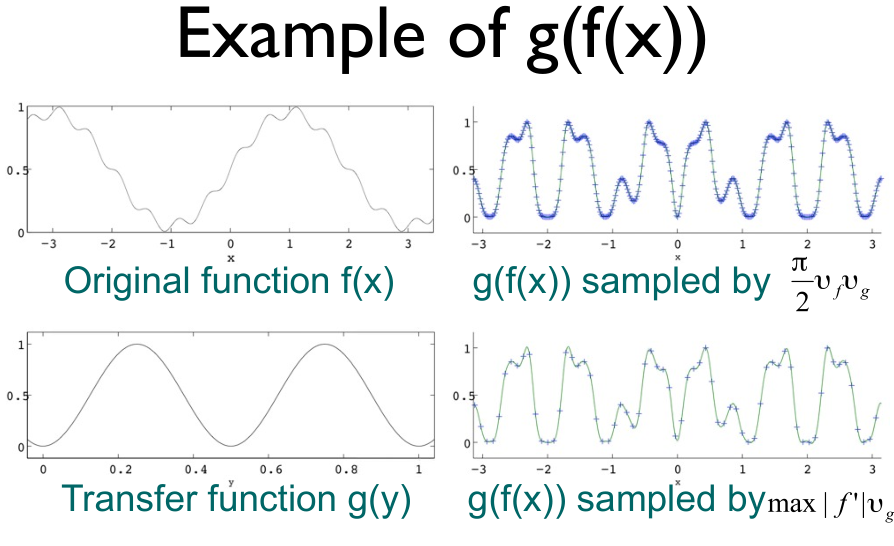
<p><img src="/assets/img/gofx-example.png" alt="alt text" title="Fourier domain analysis of function composition" />
We study function composition as a fundamental data processing step.
Assuming bandlimiting frequencies $\nu_f$ and $\nu_g$ of the two functions $f$ and $g$, respectively,
a less conservative, coarser sampling rate is derived that still
enables accurate reconstruction of the composed function $g(f(x))$ refered to as $h$ in the following.</p>

<h2 id="hint-for-reading-the-paper">Hint for reading the paper</h2>

<p>The simplified explanation provided below treats the problem for one-dimensional functions $f, g:\RR\to\RR$ and avoids the use of polar coordinates to represent combinations of frequencies $k,\,l$.</p>

<p>The <a href="/assets/pub/bergner2006gofx.pdf" title="IEEE TVCG publication PDF">paper</a>’s main result is that $\nu_h = \nu_g\max_x|f’(x)|$ (<strong>Eq. 13</strong>). In other words, the quasi-bandlimiting frequency $\nu_h$ of the composed function $h$ is proportional to the extremal slope of $f$ times the bandlimiting frequency $\nu_g$ of $g$.</p>

<p>The relevance of having an estimate for the bandlimit $\nu_h$ of the composed function is that <a href="https://en.wikipedia.org/wiki/Whittaker%E2%80%93Shannon_interpolation_formula#Definition">Shannon’s sampling theorem</a> implies a step size $T\sim 1/\nu_h$ for a uniform sampling of $h$ that enables its perfect reconstruction.</p>

<p>To follow the derivation of Eq. 13, first note that Eqs. 6 &amp; 7 imply that if $P(k, l)\approx 0$ for all $k&gt;\nu_h$, the resulting frequency spectrum $H$ of the function $h$ is going to have a (quasi) bandlimit $\nu_h$. Inspecting the form of
$P(k,l)=\int_\RR e^{ilf(x)-kx}dx$ (<strong>Eq. 5</strong>) in Section 3.2, we recognize it as an integral over an oscillating integrand with unit magnitude and phase $u(x)=lf(x)-kx$.</p>

<p><a href="https://en.wikipedia.org/wiki/Stationary_phase_approximation">Stationary phase approximation</a> is a standard analytic method that enables an approximation of the integral $P(k,l)$ by only considering contributions of its integrand where the phase of oscillation $u$ “slows down to a halt”, i.e. where $du/dx=0$, refering to such points as $x_s$. Since Eq. 5 integrates over $x$, the parameters $k$ and $l$ of $u$ can be considered constants in the integral and stationary phase will occur wherever $k/l=f’(x_s)$. Now, the result in Eq. 13 can be established if the slope $f’$ of $f$ is bounded and noting that the largest frequency $l$ of relevance to non-zero portions of the spectrum $H$ in Eq. 6 is $\nu_g$, the bandlimit of $g$.</p>

<p>The paper follows a different path of explanation to satisfy further technical conditions of the method and also to obtain a further statement about the “quasi”-ness of the bandlimit $\nu_h$, i.e. showing that $H$ decays exponentially beyond this limit.</p>

<h2 id="2026-note-composition-interchange-and-provenance">2026 note: composition, interchange, and provenance</h2>

<p>I am reopening this result as a focused follow-up note, not replacing the 2006
paper. The core object remains the composed observable $h=g\circ f$, but the
current emphasis is different: under which stated conditions may a composed
quantity be rewritten, sampled, archived, and re-entered without losing the
conditions that made the rewrite valid?</p>

<p>In the original derivation, the visible move is spectral: separate the
contribution of the transfer function from the scalar field and estimate the
frequencies that matter for reconstruction. The new addendum should make the
admissibility conditions more explicit: the relevant function spaces, the
measure-theoretic interchanges behind the representation, the operator view of
composition, and the regime in which stationary phase is a controlled
approximation rather than a silent identity.</p>

<p>The same discipline applies to publication. A future release should first be a
citable archival object, for example a versioned release with a DOI and
DataCite-style metadata. A content hash and timestamp proof can then serve as a
provenance receipt: a way to witness that a specific file existed in a specific
form. Content-addressed storage or a timestamping protocol may be useful here.
Tokenization, if used at all, should not replace citation. It should be a
lightweight receipt or sponsorship layer pointing to the archived DOI and hash,
not a speculative collectible.</p>

<p>That distinction matters mathematically as well as economically. The work is
not a new claim to own function composition. It is a renewed mathematical
reading of a published result: composition as a lawful transition between
representations, where proof obligations, approximation regime, and publication
receipt are all part of the object being communicated.</p>]]></content><author><name>Steven Bergner</name></author><category term="research" /><summary type="html"><![CDATA[Before rendering, data values $f(x)$ at given spatial positions $x$ have to be assigned optical properties and visibility. In mathematical terms this corresponds to function composition $g(f(x))$. We describe the composition as a linear operator and conduct a spectral analysis to estimate a suitable sampling frequency in $x$ to reconstruct the composed signal. We put the theoretical insight to practical effect by implementing a raycaster with an adaptive sampling scheme based on our new estimate.]]></summary></entry><entry><title type="html">Physically-based rendering for 3D medical reconstruction</title><link href="https://stevenbergner.github.io/research/2005/10/23/pbrt-medical-reconstruction.html" rel="alternate" type="text/html" title="Physically-based rendering for 3D medical reconstruction" /><published>2005-10-23T00:00:00+00:00</published><updated>2005-10-23T00:00:00+00:00</updated><id>https://stevenbergner.github.io/research/2005/10/23/pbrt-medical-reconstruction</id><content type="html" xml:base="https://stevenbergner.github.io/research/2005/10/23/pbrt-medical-reconstruction.html"><![CDATA[<p>I per-used <a href="http://www.pbrt.org/">PBRT</a>, a computer graphics framework for global light transport simulations, to reconstruct the shape of the distribution of a radiating tracer inside the patient’s body from projections recorded by a gamma camera for SPECT. This work illustrates an interesting overlap in research questions in graphics and medical reconstruction that goes beyond rendering for display purposes.
It can be read about in our <a href="/assets/pub/bergner-mic05.pdf" title="Using PBRT for medical reconstruction">MIC 2005 paper</a>.</p>

<table>
  <tbody>
    <tr>
      <td><img src="/assets/img/phrec-backproj.jpg" alt="" title="Back-projections of photon densities recorded from different angles" class="center-image" /></td>
      <td><img src="/assets/img/phrec-backproj-shield.jpg" alt="" title="Reconstruction of volumetric photon density" class="center-image" /></td>
    </tr>
  </tbody>
</table>

<p>In this scene, path tracing is used to simulate densities of photons that arrive at points on a volumetric grid. In the simulation, the light transport is inverted from how radiation from tracers inside the patient’s body is detected by outside cameras in the SPECT imaging.</p>

<p>The left picture illustrates the (inverted) incoming radiation from different camera angles by inserting quadratic screens around the volume in the center. In the right image, the screens are removed and the density of photon paths simulated under Compton scattering is shown in the light emitting volume.</p>]]></content><author><name>Steven Bergner</name></author><category term="research" /><summary type="html"><![CDATA[I per-used PBRT, a computer graphics framework for global light transport simulations, to reconstruct the shape of the distribution of a radiating tracer inside the patient’s body from projections recorded by a gamma camera for SPECT. This work illustrates an interesting overlap in research questions in graphics and medical reconstruction that goes beyond rendering for display purposes. It can be read about in our MIC 2005 paper.]]></summary></entry><entry><title type="html">Learning kernels for spatio-temporal-chromatic image data</title><link href="https://stevenbergner.github.io/research/2005/05/01/basis-patches.html" rel="alternate" type="text/html" title="Learning kernels for spatio-temporal-chromatic image data" /><published>2005-05-01T00:00:00+00:00</published><updated>2005-05-01T00:00:00+00:00</updated><id>https://stevenbergner.github.io/research/2005/05/01/basis-patches</id><content type="html" xml:base="https://stevenbergner.github.io/research/2005/05/01/basis-patches.html"><![CDATA[<p>We look at patches (space-time cubes) of color image sequences and
conduct independent (ICA) and principle component analysis (PCA) to obtain
different basis functions. While the PCA basis functions optimally
represent the data in a least squares sense, ICA basis functions are
more suitable for entropy-based variable length encoding. Applied to
image compression this advantage became particularly apparent for low
bit rates.  The work is described in our <a href="http://www.cs.sfu.ca/~mark/ftp/Icip05/icip05.pdf">ICIP 05
paper</a> (<a href="/mybib.html#stcbase">bibtex</a>). An extended version has been published at Signal Processing: Image Communication <a href="http://dx.doi.org/10.1016/j.image.2008.05.006">[doi]</a>.</p>

<p><img src="/assets/img/ica-basis.jpg" alt="" title="basis functions obtained using ICA on patches of natural images" class="center-image" /></p>

<p>The picture shows different kernels with time progressing from left to right. The kernel on top can detect vertically moving edges, below that we find a detector for non-moving diagonal edges, then a horizontal color edge, color transition from blue to green, etc. See our publication for more, higher-resolution examples.</p>

<p>These basis functions have been generated for a set of natural images.
While motivated from an image encoding perspective, we point out that using these basis patches for feature detection is very similar in spirit to employing convolutional neural networks that have been pre-trained for a certain class of images (e.g, compare Fig. 3 in <a href="http://papers.nips.cc/paper/4824-imagenet-classification-with-deep-convolutional-neural-networks.pdf">AlexNet 2012</a> with Fig. 4 in <a href="http://www.cs.sfu.ca/~mark/ftp/Icip05/icip05.pdf">our earlier work</a>).</p>]]></content><author><name>Steven Bergner</name></author><category term="research" /><summary type="html"><![CDATA[We look at patches (space-time cubes) of color image sequences and conduct independent (ICA) and principle component analysis (PCA) to obtain different basis functions. While the PCA basis functions optimally represent the data in a least squares sense, ICA basis functions are more suitable for entropy-based variable length encoding. Applied to image compression this advantage became particularly apparent for low bit rates. The work is described in our ICIP 05 paper (bibtex). An extended version has been published at Signal Processing: Image Communication [doi].]]></summary></entry><entry><title type="html">Ant classification using structured deformable shapes</title><link href="https://stevenbergner.github.io/research/2003/12/18/deformable-models.html" rel="alternate" type="text/html" title="Ant classification using structured deformable shapes" /><published>2003-12-18T00:00:00+00:00</published><updated>2003-12-18T00:00:00+00:00</updated><id>https://stevenbergner.github.io/research/2003/12/18/deformable-models</id><content type="html" xml:base="https://stevenbergner.github.io/research/2003/12/18/deformable-models.html"><![CDATA[<p>By matching structural body shape models of several ant species to a macroscopic color image morphological features of the specimen are detected. This enables a proof of concept implementation for semantic content based image retrieval for the <a href="http://insects.oeb.harvard.edu/mcz/">MCZ Type Specimen Database</a> @ <a href="http://www.mcz.harvard.edu/Departments/Entomology/">Harvard Entomology</a>.
<img src="/assets/img/sdm-framework.jpg" alt="alt text" title="Structural Deformable Model Framework" />
The code <a href="https://github.com/git-steb/structural-deformable-models">is available on GitHub</a>
with <a href="https://git-steb.github.io/structural-deformable-models/">auto-generated documentation</a>.</p>

<p>The hierarchical recognition model contains:</p>
<ul>
<li> a compound deformable model where occurrence of structural components influences the distribution for search for further shapes (e.g. a neck should be near the head and vice versa),</li>
<li> a finite element model of deformable shape components, for which the involved physical parameters are learned from training data,</li>
<li> a multi-scale feature extraction including color edge and corner detection,</li>
<li> a parametric Gaussian color space model for ant skin classification.</li>
</ul>
<p>All details are published in <a href="/assets/pub/thesis_bergner03.pdf">my thesis</a> (<a href="/mybib.html#dsmthesis">bibtex</a>) and a summary is provided in the <a href="/assets/pub/bergner-deformable-models-icip04.pdf">ICIP04 paper</a> (<a href="/mybib.html#dsmicip">bibtex</a>).</p>]]></content><author><name>Steven Bergner</name></author><category term="research" /><summary type="html"><![CDATA[By matching structural body shape models of several ant species to a macroscopic color image morphological features of the specimen are detected. This enables a proof of concept implementation for semantic content based image retrieval for the MCZ Type Specimen Database @ Harvard Entomology. The code is available on GitHub with auto-generated documentation.]]></summary></entry></feed>